

Emotionally Non-Stick: A Dosa Love Story

"When friendships turn into calendar invites and weekend plans leave you ghosted, you return to the past. This is a crispy tale of love, loneliness, and the golden science of letting go—told through a dosa."

The Setup
Dosa, My Love
Lately, I’ve been spending more time in the kitchen.
In your late 20s, friendships thin out.
Weekend plans vanish into work emails.
“Catching up” becomes a calendar event that keeps getting postponed.
So, I made dosas for the people I still hold close, including myself.
I enjoyed quiet time with my dad.
And took my mother and sister out for a meal.
Over the past year, I’ve learned a lot about attachment and detachment—
Much like a dosa on an iron pan.
Let me explain how I make a dosa attach and detach.

The Batter
The recipe begins with soaking rice and lentils in water—
Let’s call this their bromance phase.
After soaking, they’re ground into a batter and left to ferment overnight.
By morning, the excess love is practically overflowing—
Foamy, airy dosa batter bubbling with anticipation.
Now, let’s make dosa!
First things first, I use only an iron pan.
Place the iron pan on the stove over a high flame and let it absorb enough heat.
Hold some drinking water (don’t worry, I’m not asking for Himalayan Spring water—just use filtered water) and sprinkle it over the pan—
Like a French chef flamboyantly dusting grated cheese on a pizza.
Here’s my secret: while making dosa, change your identity.
Unfocus your mind.
Imagine yourself as the best chef in the world.
That’s how I make the best dosas.

The Sizzle
Watch the water droplets dance and sizzle on the pan—
Shrinking and disappearing into the iron.
This is the moment you prepare the pan for love.
Now, take an onion and cut it in half.
(I see you crying, but relax—it’s just the onion layers, not heartbreak.)
Hold the top half by its stem and rub the cut side over the pan.
This gives the iron a beautiful matte finish.
Tilt the pan diagonally, and you’ll see the difference.
Keep the pan on a high flame throughout this process.
Now comes the magic.
Hold the batter container in your left hand and scoop some batter with a ladle.
Pour it right in the center of the pan—
And listen closely.
You’ll hear a delightful “Tschüss” (which, fun fact, is German for “bye”).
This sound confirms that the dosa has successfully fallen for the pan—
And is now attached.

Detachment
The next step is a bit tricky, so be patient.
Using the ladle, spread the batter outward in concentric circles—
Three to four should do, keeping them within the pan’s radius.
Observe as tiny bubbles pop—
Creating little voids, just like life itself.
Now, look for a golden-yellow hue forming around the edges.
This is the moment of detachment.
To help the dosa on its journey, apply a little butter—
It’s like a comrade standing by its side.
When it starts feeling just right, gently fold the dosa using a flat-headed spatula.
(Note: Do NOT flip it over! If you do, I will haunt you in your dreams!)
Carefully transfer the dosa to a nearby plate.
Serve it with red-hot chutney.
Oh, and don’t forget the mashed potato filling—
It’s what completes the love story.
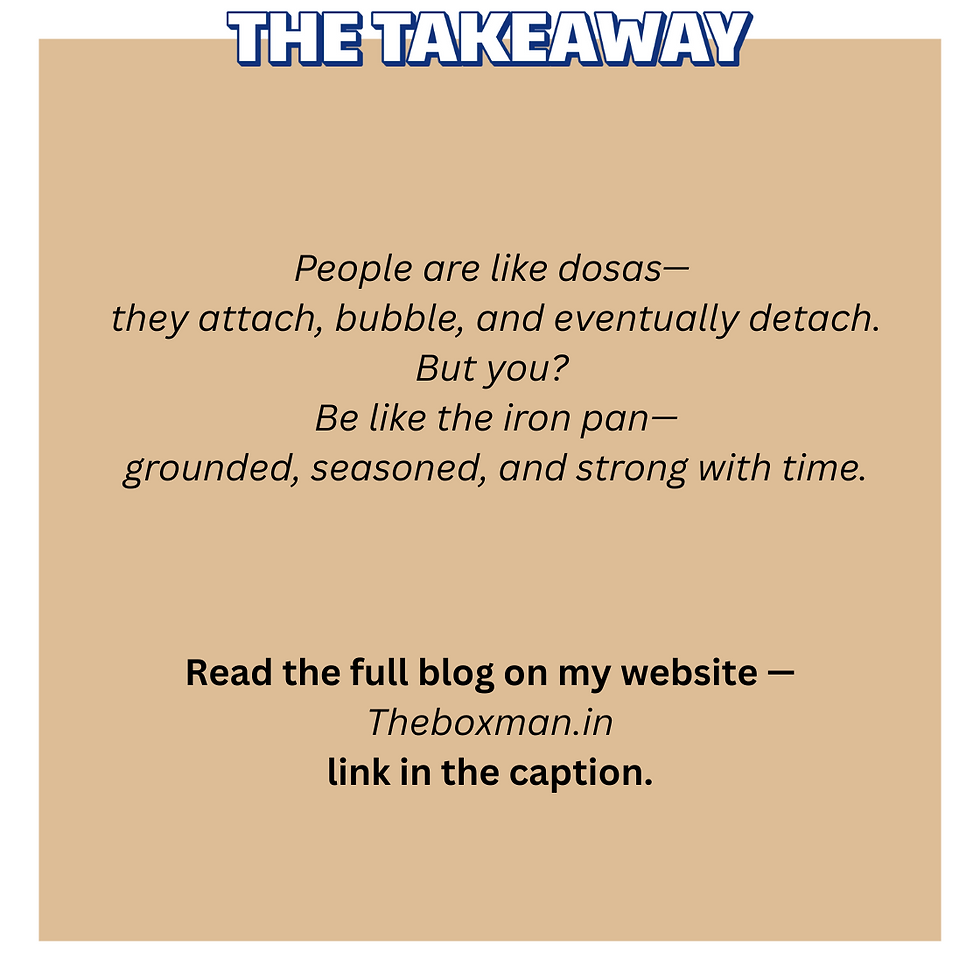
These days, I’m learning that people, like dosas—
Stick for a while, bubble a little, and then move on with grace.
But every once in a while, you meet someone who understands the fun of dosa—
And doesn’t try to flip it.
P.S. I told a girl about my dosa-love metaphor—attachment, detachment, golden edges.
She listened, smiled, and said, “Funny thing—my mom never ate with us while making dosas or chapatis.”
“She was always standing, serving, missing the meal herself.”
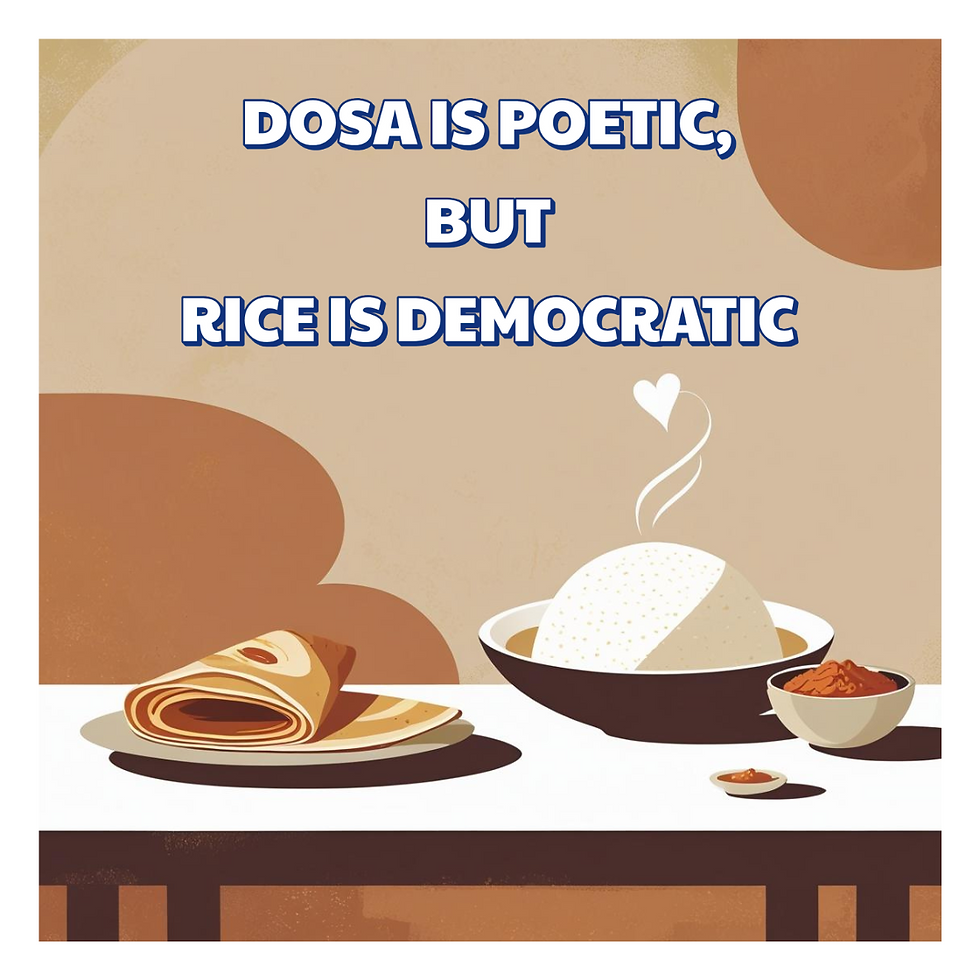
“That’s why I love rice,” she added. “Everyone eats together.”
I laughed and said, “Fair enough—dosa is poetic, but rice is democratic.” 😄
May your dosas always be crispy, and your heart always warm.
So, what do you think?
Is dosa a love story—or is rice the real comfort?
Comment below—I’d love to hear your take.


Hello Boxman,
I understand you POV, but it applies well when the tawa or pan is made of Iron.
Suppose the pan is made of aluminium/stainless/ceramic then the whole story changes.
You may not be able to produce as many dosas as you did in iron pan.
The other pans may give up the job and surrender that they can no longer be able to produce the dosas.
So if you are lucky and already made of iron then you are saved but if you are not then the dosas will keep taking one layer of you each time they detache from you!!
-Manoj M D